In this post, I will explore some of the ways in which the Old Masters used brushwork and paint handling techniques to create compelling works of art. The Old Masters did not use paint in a simplistic and uniform fashion to depict reality. Instead, they used their knowledge of the properties of paint and its application—thickness, transparency, movement, texture—selectively to achieve their painterly goals. While a comprehensive technical account of their methods is beyond the scope of this post, I hope to provide readers with a helpful overview of some of their approaches. Contemporary painters can find inspiration in these techniques and incorporate them into their own art-making practice. And readers who are not artists can gain a greater understanding of how the old masters achieved such impressive results in their work.
Indirect Painting and Grisaille
There is a well-known distinction in the art world between direct and indirect painting. Direct painting involves just going for it, as it were—sitting down to paint without first establishing any supporting layers or structure. Painters who work in this fashion mix the colors that they want on their palette and apply them directly to the surface, often in one sitting. When a painter creates an entire piece before their paint dries, working wet into wet, it is referred to alla prima painting. However, not all direct painting is strictly alla prima painting since a painter can work in a direct fashion over several sessions, letting the paint dry before developing the work further. Even a painter who prefers to paint alla prima might have to paint in this way when working on a large-scale painting, since it may be impossible to cover the entire surface in one sitting. They may have to move from passage to passage over a series of painting sessions, thus applying wet paint over or next to dry paint.
While not an Old Master, John Singer Sargent seems to have proceeded in this way when working on a large-scale pieces. While painting Carnation, Lily, Lily, Rose, he painted en plein air, working quickly and covering large areas of the canvas in a single session (Hellen and Kilmurray 5). He was particular about lighting and could only work in 25-minute increments to capture the scene at the right time of day. Later, after examining the painting in the studio, he would use the side of his palette knife to scrape down portions of the painting that he judged to be unsatisfactory. He would rework these areas later—repeatedly scraping, if necessary—until he was pleased with the result. X-radiograph imaging of the painting reveals pentimenti, evidence of earlier compositional decisions beneath the final layer of paint (9-10).

Carnation, Lily, Lily Rose, by John Singer Sargent
Indirect painting, in contrast, involves deliberately developing a piece over several sessions with the intent of achieving a certain desired outcome. The Old Masters often used this method to create the luminous, remarkably lifelike skin tone and texture that you sometimes find in their work. When you see skin in a painting that is so dazzling and convincingly painted as to seem impossible, it is often the result of indirect painting. Although the indirect painting method used varied from artist to artist, it typically began with a monochromatic underpainting, or first (“dead”) layer, which captured the form, structure and values of the painting. The word grisaille means gray (from the French word, gris), so this form of underpainting would have been created using some combination of paints that resulted in a scale of neutral grays. But other painters working in the same fashion used different hues for their underpaintings, e.g., a verdaccio (or greenish gray) or brunaille (brown). After the painter completed an underpainting that was accurate in terms of both form/structure and value, they would often add transparent paint in layers until they had achieved the desired color relationships. This painting technique of adding transparent paint over dry paint is known as glazing. Although glazing is often used over an underpainting, as I have described here, to add color over value, it can be used for other purposes as well. A painter who has otherwise worked in a direct or alla prima fashion might glaze over a region of a painting to make it recede or become less prominent. Alternatively, they may want to modify a color that is already set down without having to repaint the entire area. If we understand the traditional painting techniques of the Old Masters, we can use or refashion them for our own purposes. Sometimes the most interesting contemporary paintings employ multiple traditional painting techniques used selectively throughout a piece to great effect. Without giving away all his secrets, one of my painting teachers, Hongnian Zhang (mentioned earlier) developed a version of this approach that uses chromatic neutrals based upon his own color palettes.
After glazing, painters would often reclaim light regions of the painting through scumbling or scrubbing light paint over the surface with a dry brush. This would create an “opaque, inconsistent, broken layer” on top of a darker layer. The word is derived from “scum,” an obsolete variant of skim. Although scumbling is often used in portraiture when painting skin tone, the technique can be employed in a variety of other painting scenarios to create texture, optical blending, and a sense of movement and vitality.
To be sure, not all painters who painted indirectly did so in exactly this fashion or order. For example, Ernst Van de Wetering claims that Rembrandt typically began his paintings with a warm brown dead layer or underpainting on a yellowish-brown ground. From there, he would start painting straightaway with opaque paint, working from back to front, developing one area at a time, making adjustments to earlier painted areas as needed (23-44). Known for his thick and textural application of paint, he did not rely as heavily upon glazing as, say, da Vinci did. While he integrated glazing into his painting practice, it was not his primary means of differentiating color and articulating form (197).
Texture and Impasto
When painting a shadow, or an area that recedes into the distance, a painter will often use dark, thin paint. But when they want to indicate that an area advances toward the viewer, they will often use lighter and thicker paint. Rembrandt’s work is probably the best example of this. In my last post, I looked at how he arranged values in his portraits to create the illusion of form and three-dimensionality. But I want to add here that he was also not afraid to use an impressive amount of paint and texture in this process when capturing the light areas of a sitter’s face. It is hard to fully appreciate the textural aspect of his work and the full beauty of his paintings without seeing them in person. And the experience of admiring these paintings from a distance and then inspecting them close-up is both illuminating and awe-inspiring. His paintings are far looser and more abstract when viewed up close than one might expect. Consider the two photographs (below) from his Head of a Bearded Man: Study for Saint Matthew that was on display at the AGO in Toronto when I visited in 2025.
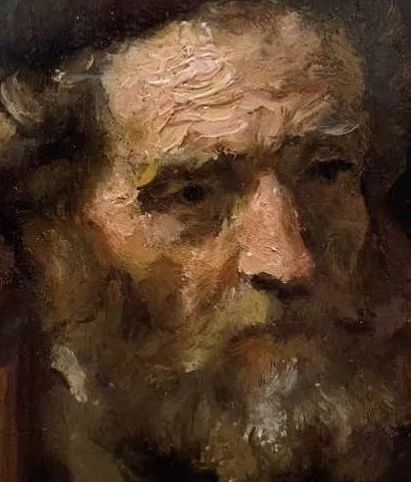
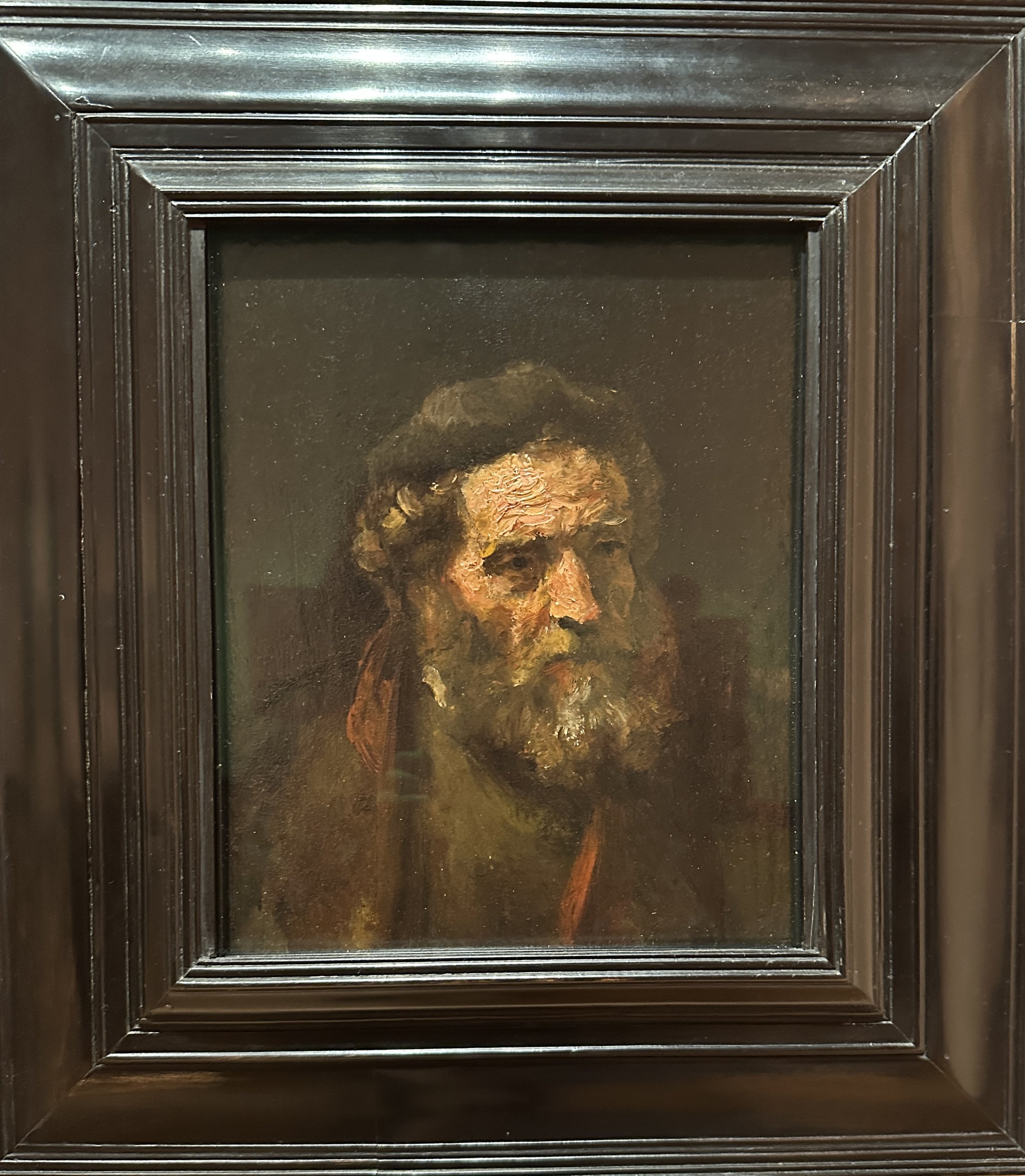
The paint in the background is thinly applied and dark. The clothing and the chair on which the man is sitting meld with the background. But when inspected up close, you can see just how astoundingly thick the paint is on the illuminated left side of his face, particularly on the forehead. The use of impasto, or the thick, textural application of paint, enabled Rembrandt to capture light and dimensionality in his paintings. As we have seen, value relationships alone can capture light and the illusion of form. However, the way that paint is applied can accentuate this effect. Again, thin paint recedes, and thick paint advances in space. Importantly, thick paint accompanied by visible brushwork will catch the light in a room, thereby enhancing the illusion of three-dimensionality and making the passage in question more prominent.
Sfumato
Leonardo da Vinci’s painting practice was influenced by his own scientific study of optics. His Treatise on Painting reveals how closely his own approach to painting was tied to his scientific understanding of the world. He was able to translate his own understanding of nature and vision into his artistic work, thereby achieving an impressive level of subtlety and realism. Da Vinci did not use the term sfumato but expressed its principal ideas in different words throughout his writing on painting. The term, sfumato (from Italian sfumare, “to evaporate like smoke”) was invoked later to describe his work and method of painting. It refers to the soft transitions and subtle gradations that are found in his work which create an atmospheric effect and convincing realism. He achieved this by eliminating hard outlines, which are not found in nature, and instead carefully blending the transitions between different areas of his paintings. In A Treatise on Painting, he observes that the
boundaries which separate one body from another, are of the nature of mathematical lines, but not of real lines. The end of any colour is only the beginning of another, and it ought not to be called a line, for nothing interposes between them, except the termination of the one against the other, which being nothing in itself, cannot be perceivable; therefor the painter ought not to pronounce it in distant objects. (106)
By eliminating outlines, and softening transitions, da Vinci was able to achieve a greater sense of realism than many of his predecessors. Elsewhere da Vinci instructs painters to depict shadows and lights “without strokes or marks, in the manner of smoke” (“senza tratti o segni, a uso di fumo)” (p.11). In his discussion of da Vinci’s use of sfumato, Alexander Nagel remarks that he had achieved the height of mimesis in his work; his technique had captured nature as it appears to the viewer and left no traces of the artist’s hand (14-15). Technical analysis of his paintings reveals that da Vinci also painted indirectly, developing his paintings through layers of oil with very little pigment. He utilized glazing, scumbling, and varnishing to create works of remarkable realism (15).
Expressive Brushstrokes
To be sure, not every painter is preoccupied by the mimetic project. Influenced by his own work in optics, da Vinci set about painting reality as it appears to the human perceiver, leaving no trace of the artist in the painting. Many contemporary painters have abandoned the mimetic project altogether and have entirely different artistic goals. Still others working within the tradition of realism want their painting to look like paintings and welcome evidence of the painter’s hand. Yes, they may want to represent or depict reality in their work, but not so much so that their paintings cease to look like paintings. We can see this difference of approach even among the Old Masters themselves; contrast da Vinci’s sfumato with Rembrandt’s impasto. Rembrandt used visible brushwork and the thick application of paint to describe form, light and texture. There is a vitality to his work. Virgil Elliott remarks that while indirect painting may allow a painter to achieve the highest form of realism, direct painting with looser brushwork imparts to a work a certain charm that is lacking in the former—a quality that many modern painters have sought to embrace. He writes:
The direct painting technique is more widely used in modern times than any other. Its appeal is not, like the Venetian technique [a form of indirect painting], that it fools the viewer into believing that a living person is there instead of canvas and paint, but rather that it possesses a certain charm precisely because the viewer can readily see the brushstrokes, the globs of paint, etc., that go into the creating of the image. The method is not hidden from the viewer, who is then able to feel a little closer to the artist and thereby may enjoy the picture all the more. (166)
Frans Hals also used expressive brushwork when creating his lively, often mischievous portraits. The brushwork in his portraits, as in Rembrandt’s, conveys a sense of energy or vitality. It is particularly well-suited for his subjects, which are often smiling—a rarity in portraiture. The sitters are not still and reserved, like the Mona Lisa, but ebullient and playful. Consider the following portrait, which I am especially fond of because it includes an owl (the symbol of wisdom and philosophy):
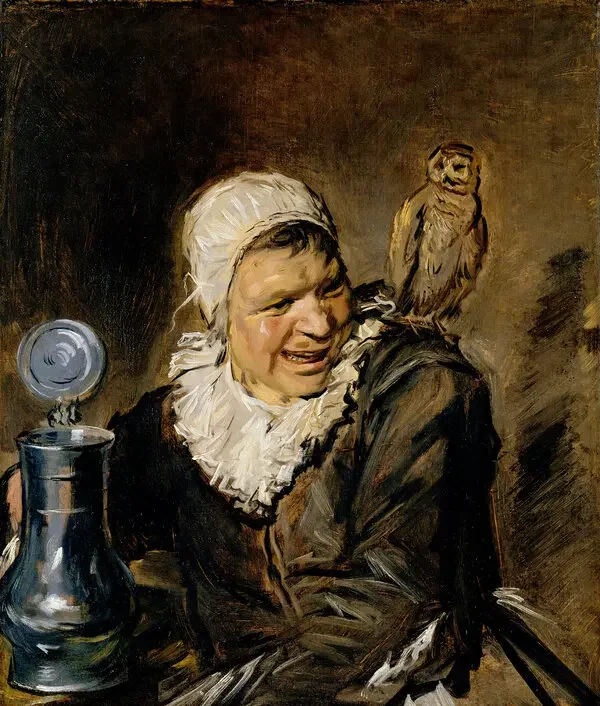
Malle Babbe, by Frans Hals
I doubt that Hals would have been able to capture the spirit and expression of this character were it not for his energetic brushwork. His loose, insouciant style and bold brushstrokes made him an important precursor of impressionism and a pioneer of modern painting.
Since the days of the Old Masters, painters working within various traditions—depicting diverse subjects—have embraced expressive brushwork and impasto. Just as value (or tenebrism, in particular) can be used to convey or express a certain mood or feeling, so also can impasto and brushwork. As we have seen, Hals used bold brushwork, at least in part, to express something about his sitter’s personality and spirit. Later Vincent van Gogh used impasto and expressive brushwork in his depictions of nature and the cosmos. Arguably, his expressive approach to painting reveals as much about himself as it does about his subject matter. Again, as Elliott observed, this is the charm of the direct approach.
Just as there is no one right way to paint, there is no single path to realism. Contemporary painters can draw from the rich lessons of art history, utilizing the strategies and techniques of the old masters to suit their unique purposes. In my next and final post in this series, I will look at how the Old Masters directed attention in a painting through selective detail and development.
Further Reading
Elliott, Virgil. Traditional Oil Painting: Advanced Techniques and Concepts from the Renaissance to the Present. Watson-Guptill, 2007.
Hellen, Rebecca, and Elaine Kilmurray. “Carnation, Lily, Lily, Rose and the Process of Painting.” British Art Studies, no. 2, Paul Mellon Centre for Studies in British Art and Yale Center for British Art, 2016, https://doi.org/10.17658/issn.2058-5462/issue-02/rhellen-ekilmurray.
Nagel, Alexander. “Leonardo and Sfumato.” RES: Anthropology and Aesthetics, no. 24, Autumn 1993, pp. 7–20. The University of Chicago Press, https://doi.org/10.1086/RESv24n1ms20166875.
Van de Wetering, Ernst. Rembrandt: The Painter at Work. Rev. ed., University of California Press, 2009.
Zhang, Hongnian, and Lois Woolley. The Yin/Yang of Painting: A Contemporary Master Reveals the Secrets of Painting Found in Ancient Chinese Philosophy. Watson-Guptill, 2000.