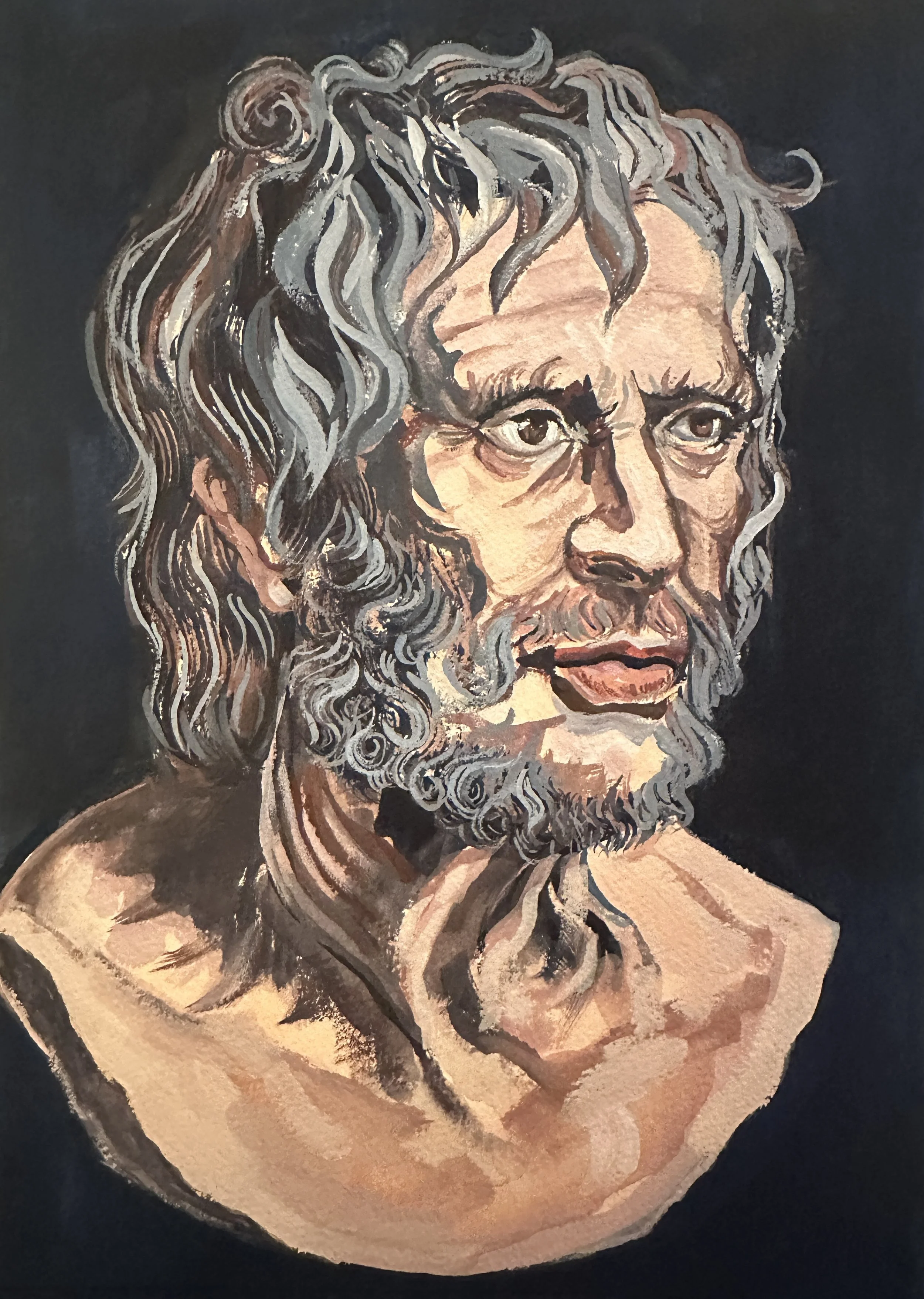
While doing some teaching preparation for a course on death, I recently picked up Seneca’s On the Shortness of Life (hereafter “The Shortness”). Although I read this years ago, I returned to it to reacquaint myself with Seneca’s central argument. In the book, Seneca offers sage advice about how to live a full and intentional life with the amount of time that we have been given. He believes that if we implement his philosophy, and live life in accordance with his principles, then we will not complain of having too little time when death comes knocking. In this post, I do not want to take up Seneca’s central claim that a well-lived life is long enough, about which I have some misgivings. Instead, I examine his treatment of music. Seneca regards music as a mere diversion and waste of time; at best, it—like the other liberal arts—has derivative value insofar as it prepares the soul for virtue. I provide grounds for rejecting this view and then offer my own positive account of how music, and the arts more generally, can contribute to a flourishing human life. While music may prepare the soul for virtue, it is valuable quite apart from this and makes its own contribution to a flourishing human life— a life whose value is not exhausted by virtue.
The main thesis of The Shortness is that human beings, finite though we be, have enough time to live rich and fulfilling lives so long as we use our time wisely. People who complain about the shortness of life, and long for more time toward the end, have generally squandered their lives. Seneca persuasively argues that most people get pushed and pulled about throughout life, failing to live intentionally. Clearly, this argument can be made with far greater force today as people are often tethered to their phones and manipulated by social media algorithms. While such people may exist for a long time—becoming old and grey—they may not live for a long time, which demands something more. In this respect, they resemble a sea voyager who, shortly after leaving the harbor, has been caught up in a storm by strong winds, only moving in a circle. Seneca tells us that such a man has not had much of a voyage; he has only been “tossed about” (14). Many of us fail truly to live; we are just tossed about, like Seneca’s sea voyager.
Seneca is right to emphasize the importance of intentional living—of planning out every day as though it were our last (14). And I love the imagery of a voyager being tossed about in the winds, like the plaything of fate. But when we dig a bit deeper, and consider what he means by living, we might find his view less convincing. For Seneca, a life well lived is one that is dedicated to philosophy and the cultivation of the virtues. Moreover, a liberal education, which for Seneca includes mathematics, poetry, language and music, is only worthwhile insofar as it prepares the soul for the study of philosophy and cultivation of virtue. In The Shortness, he denounces men who spend their lives greedily feasting at banquets, watching young men wrestle, or tending to their appearance with meticulous attention at the barber. These men are wasting their time; not spending it on worthwhile pursuits. But Seneca includes in this same category the musician. The person who composes and learns songs is no better, in this regard, than the vain man who whiles his time away at the barber, making sure that his hair falls “into its proper ringlets” (23). He writes:
And what of those who are engaged in composing, hearing, and learning songs, while they twist the voice, whose best and simplest movement Nature designed to be straightforward, into the meanderings of some indolent tune, who are always snapping their fingers as they beat time to some song they have in their head, who are overheard humming a tune when they have been summoned to serious, often melancholy matters? These have not leisure but idle occupation. (23)
For Seneca, a life dedicated to the creation of music is a wasted or misapplied life. To be sure, the person, in his example, who hums a happy tune at a solemn event is behaving inappropriately. But it does not follow from this that creation of music is always inappropriate or wasteful. Contrast the person who hums a happy tune at a funeral with the person who plays a mournful piece of music at the funeral to honor the deceased and their family. Indeed, writing or playing music to honor the deceased itself seems to involve the exercise of virtue. It involves compassion and generosity—feeling for others and giving of oneself for them.
Seneca expresses his disapproval of music again in Letter 88, “On Liberal Studies,” from Letters to Lucilius:
Now I will transfer my attention to the musician. You, sir, are teaching me how the treble and bass are in accord with one another, and now, though the strings produce different notes, the result is a harmony; rather bring my soul into harmony with itself, and let not my purposes be out of tune. You are showing me what the doleful keys are; show me rather how, in the midst of adversity, I may keep from uttering a doleful note.
As a professional philosopher myself, I am sympathetic to Seneca’s claim that a worthwhile education should include philosophy and prepare us for virtue. Moreover, I agree that many disciplines, including contemporary philosophy, can get caught up in hairsplitting disputes that seem not to improve the quality of our lives. But Seneca goes too far in claiming that all our attention—the entirety of our education—should be dedicated to the cultivation of virtue.
It makes sense that philosophy, which asks fundamental questions about what matters, should be at the core of an education, since it can help us prioritize our learning and academic pursuits. But it should not dominate an education or a life. Philosophy, when put to good use, can help us make decisions about how to live well—how to flourish as human beings.
In the Nicomachean Ethics, Aristotle claimed that, if we want to know what it means to live well as a human being, then we need to know something about a human being’s function. This, in turn, requires that we know what is uniquely human—what separates us from plants and animals. Aristotle believed that reason is what separates us from other living beings. And so, he concluded, acting in accordance with reason, and doing this well (with excellence) is what it means to live well as human being—to live a eudaimonic life. This, as Aristotle understood it, meant living in accordance with the virtues. While I have never found this argument entirely convincing, I think that Aristotle was onto something. He was right in believing that what it means to thrive, live well or flourish, as a being depends upon the properties, abilities, or nature of the being in question. Surely, he was correct in thinking that what it means to live well as a human being is different from what it means to live well as a toad or pine tree. So far, so good. But he goes wrong in believing that we differ from plants and animals in terms of reason alone. Reason is conceptually distinct, but related to intelligence, and we have more of the latter than plants and animals, too. Indeed, we seem to differ from plants and animals in terms of an array or web of higher cognitive abilities. “Reason” seems too narrow to capture these differences. Of particular interest to me here is how these cognitive differences allow us to make and appreciate the arts and have aesthetic experiences.
We are not just rational beings, we are also aesthetic beings. We not only differ from plants and animals in terms of our ability to reason, and act in accordance with the virtues, but also in terms of our ability to compose symphonies and paint oil portraits. If living well as a human being involves acting in accordance with our uniquely human traits, then this surely involves engaging in the arts. If this is correct, then Seneca is mistaken in thinking that music is a mere diversion or a waste of time. He also presents us with a false dichotomy of sorts: Instead of teaching us how to harmonize the notes of an instrument, the musician should teach us how to harmonize our souls. But pace Seneca, there seems to be room for both in a fulfilling life. A life preoccupied with virtue would seem to be an impoverished, one-dimensional existence. To be sure, it is sometimes argued that moral considerations should dominate our lives—that we should become moral saints. But it is generally recognized that a life of this kind runs counter to our human nature and is unachievable, if not, undesirable for us. It may be possible for a human being to forsake all art and live a life dominated by moral considerations, just as it may be possible for a bird to spend its life inside a cage. But like the bird, we would live a frustrated and unfulfilled life—one incompatible with our nature as aesthetically sensitive beings.
Music, I think, can prepare us for virtue. It can cultivate, or at least give expression to, emotions that underpin or support moral responses and actions. And while learning about musical harmony may not itself harmonize one’s soul, it can bestow upon a composer the ability to create music that may, in some cases, help to harmonize the soul. Many of us turn to the arts when we are dejected or in a state of despair; music that seems to express how we feel can provide us with comfort or be cathartic. It can help to restore tranquility to a restless mind. Indeed, there is a growing body of evidence that music and sound can help regulate the nervous system. And learning to play an instrument, and master scales, can help us become patient, hardworking, and conscientious. But the value of music is not simply derivative. It is valuable beyond any role that it might play in improving character or helping us live virtuous lives.
In Victor Hugo’s Les Miserables, there is a scene in which Madame Magloire chastises the pious and frugal Bishop, Charles-François-Bienvenu Myriel, for growing flowers on a plot of land that could otherwise be used for vegetables. “Monseigneur, you who turn everything to account, have, nevertheless, one useless plot. It would be better to grow salads there than bouquets.” The Bishop responds wisely, “Madame Magloire . . . you are mistaken. The beautiful is as useful as the useful.” He added after a pause, “More so, perhaps" (38). The Bishop recognized that while a flower garden may not fill a hungry stomach, its beauty may nurture the soul and inspire feelings of joy and wonder in all who pass by. To be sure, the Bishop could have devoted every inch of his garden to carrots, beets, and lettuce. And so too can we devote every moment of our lives to the cultivation of virtue. But it is a mistake to think that we could not do so without tremendous loss.
I have argued that the value of music, and the arts more generally, is not merely derivative. The arts are not valuable only insofar as they prepare the soul for virtue. But as Hugo illustrates through the Bishop, artists also give something to the world through their art. People who paint, sculpt, garden, compose, write poetry, or play an instrument fill the world with beauty and meaning. Beauty can inspire and bring us joy. This is why we bring a flower to a friend who is sick in body or mind. And the perceived meaning or feeling of a work can provide us with an almost transcendent experience—we may feel understood or at one with all human beings who have lived. We weep to sad music, feel elevated in the presence of a great painting, and find solace in poetry about loss or death, knowing that others have, too. Works of great art can help us make sense of others and ourselves.
There is much that we can take away from Seneca’s teachings about mortality, finitude, and the human condition. He is right that many people squander their lives and then complain of having too little time. Like Seneca’s sea voyager, we are often tossed about, distracted, and living without a plan. Instead, we should live our lives intentionally with an understanding that our time on earth is limited. We should study and practice philosophy, thereby preparing the soul for virtue. But we should also fill our lives with art and beauty. We are aesthetic beings, at least in part, and will not flourish as such if we purge ourselves of song, dance, and poetry.
Further Reading:
Aristotle. The Nicomachean Ethics of Aristotle. Translated by D. P. Chase, introduction by J. A. Smith, Project Gutenberg, 2003, www.gutenberg.org/files/8438/8438-h/8438-h.htm.
Hugo, Victor. Les Misérables. Translated and introduced by Norman Denny, Penguin Classics, 2012.
Seneca. “Letter 88: On Liberal and Vocational Studies.” Letters from a Stoic, Fingerprint! Publishing, 2023, pp. [page numbers].
Seneca. On the Shortness of Life. Translated by John W. Basore, Vigeo Press, 2016.