• Commissions
  • Ink
  • Oil
  • Brains, Minds, Selves
  • Other
  • Blog
  • Contact
  • Menu

Julie Elizabeth Kirsch

Drawings, Paintings, Ideas
  • Commissions
  • Ink
  • Oil
  • Brains, Minds, Selves
  • Other
  • Blog
  • Contact

Just How You Like It

March 01, 2022

Just How You Like It


Just before painting this piece, I was exploring the literature on anxiety, depression, and antidepressant use, especially among women. In some respects, taking a selective serotonin reuptake inhibitor, or SSRI (like Prozac or Paxil), might seem to be empowering. In Listening to Prozac, Peter Kramer writes of women who claimed to have become more assertive, self-assured, and confident after starting an SSRI, like Prozac. A woman who was previously timid or apprehensive might, after starting Prozac, gain the confidence necessary to request a raise or promotion. Or a woman who was highly sensitive and emotional might, on Prozac, be indifferent and unemotional enough to walk away from a toxic or unfulfilling relationship. Indeed, as Kramer reports, many women (and people in general) on Prozac come to view their earlier selves as diseased, and not as their true selves.

Others (some writers, philosophers, etc.) were more cautious and concerned about widespread antidepressant use. The National Health and Nutrition Examination Survey found that, between 2015 and 2018, 13.2% of adults 18 and over were using antidepressant medication – 17.7% of women and 8.4% of men. In a provocative article written in The New York Times, Julie Holland argues that many women who do not need to take an antidepressant are pressured (or perhaps socialized) into doing so as a way of conforming to a masculine emotional style. In her view, society has pathologized women’s natural variation in mood and emotional state. While she does not deny that some people have a legitimate need for an antidepressant, and benefit from taking one, she fears that these drugs are being overprescribed, and that many normal experiences and feelings are being medicated away. In the article, and in her book on the same theme, she mentions that many women on SSRIs are unable to cry. It occurred to one woman that her SSRI use was becoming a problem when she failed to cry in response to her own mother’s death. More recently, in Dopamine Nation, Anna Lembke expresses concern about the widespread use of antidepressants and our inability to experience the full range of emotional states while taking them.

Just How You Like It was inspired by this theme. The suspiciously happy 1950s-style housewife, donning a polka dotted apron, serves her brain on a platter to her spouse and family just how they like it. To be sure, the title, and the image itself, are sarcastic or biting in tone. To hand over one’s brain, or mind, to another amounts to a kind of self-annihilation. The act performed with a gleeful smile conceals a certain degree of contempt or resentment. In our relationships, and in society generally, we are encouraged to change or revise ourselves—through medication, clothing, cosmetic procedures, exercise, etc.— to accommodate the needs of others. This is not always an unfair or unreasonable request. It is often the case that we really ought to work on ourselves – to become kinder, gentler, more thoughtful, less selfish. But at times society, or those around us, can push too hard to make us what we are not, or to pathologize what is a normal variation in humanity.

Sources:

Holland, Julie, M.D. “Medicating Women’s Feelings,” The New York Times, Mar. 9, 2015. https://www.nytimes.com/2015/03/01/opinion/sunday/medicating-womens-feelings.html

Holland, Julie, M.D. Moody Bitches: The Truth about the Drugs You’re Taking, the Sleep You’re Missing, the Sex You’re Not Having, and What’s Really Making You Crazy. New York, Penguin Press, 2015.

Kramer, Peter D. Listening to Prozac: The Landmark Book about Antidepressants and the Remaking of the Self. New York, Penguin Press, 1997.

Lembke, Anna, M.D. Dopamine Nation: Finding Balance in the Age of Indulgence. New York, Dutton, 2021.
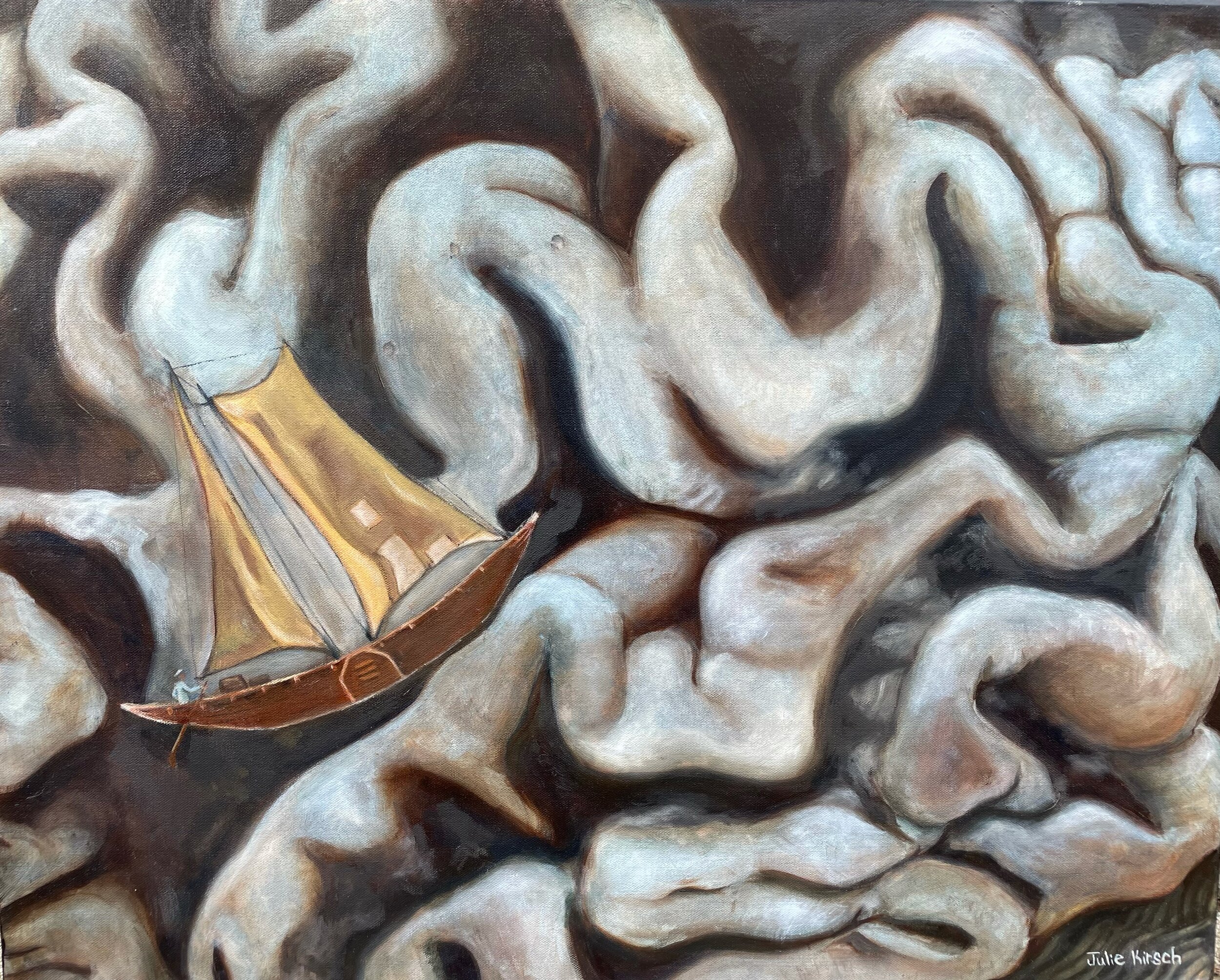
"Sailing Toward Annihilation"

August 08, 2021

There are numerous interesting and intriguing brains on display at the University of Buffalo’s Brain Museum, and I highly recommend a guided tour of the museum to anyone in the Western New York area. But the brain that had the most profound effect upon me was undoubtedly that of a person who had suffered from Alzheimer’s disease. This brain (which I will hereafter refer to as the “Alzheimer’s brain”), is visibly ravaged by the disease. Anyone who knows someone who has suffered from Alzheimer’s disease, or who has spent time in the memory impaired unit of a nursing home, knows just how devastating the disease can be at a personal level. In the early stages of the disease, memories begin to fade but loved ones are still recognized. However, as the disease progresses, loved ones are forgotten and the patient—the person—is lost altogether. I recall visiting my late grandmother in a nursing home towards the end of her life and mourning the loss of her person. I had a difficult time identifying her among a group of residents seated together in wheelchairs in front of a television, she had so visibly changed. Not only did she fail to recognize me (that had happened long ago), but she was unable to function—to use language, to communicate, to advocate for herself. She was alive, but her person—her mind— had long since vanished. And her suffering was, and had been, profound.

Around the time when I had visited the brain museum, I read a fascinating and moving article, “The Lost Mariner,” published by Oliver Sacks in The New York Review. The article told the story of a man, Jimmie R., one of Sacks’ patients, who had suffered from a form of amnesia (due to Korsakoff Syndrome) that kept him trapped in the past. After meeting with Jimmie R., Sacks wrote in his notes, “He is, as it were, isolated in a single moment of being, with a moat or lacuna of forgetting all round him…. He is man without a past (or future), stuck in a constantly changing, meaningless moment.” The title of Sacks’ article was inspired by Jimmie R., who, after being drafted in 1943, served in the navy. (Incidentally, “The Lost Mariner,” is now also a beautiful, short film by Tess Martin inspired by Sack’s article.)

Reading the article, I was reminded of my own late grandfather who had served in the Merchant Marine during WW2 and had suffered from dementia towards the end of his life. Like Jimmie R., my grandfather had been trapped in a moment, disconnected from his loved ones and earlier experiences. Without our memories, who are we? Sacks, who was poignantly aware of this, begins his article with Luis Buñuel’s reflection:

“You have to begin to lose your memory, if only in bits and pieces, to realize that memory is what makes our lives. Life without memory is no life at all…. Our memory is our coherence, our reason, our feeling, even our action. Without it, we are nothing…. (I can only wait for the final amnesia, the one that can erase an entire life, as it did my mother’s….)”

When looking at the Alzheimer’s brain, I could see gulfs, valleys—rivers—where healthy brain tissue had been eaten away by the disease. To my amazement and horror, the physical Alzheimer’s brain closely corresponded with the personal or experiential Alzheimer’s mind; a memory that had disappeared was tissue that had been eaten away. When looking at this brain, I could “see” (with my mind’s eye) a lost and lonely sailor, like my late grandfather, unknowingly sailing towards annihilation.

I dedicate this piece to my late grandmother and grandfather, whom I love and miss, and patients and families everywhere who have suffered from Alzheimer’s disease and dementia.

Prev / Next


Featured Posts

Subscribe

Sign up with your email address to receive news and updates (including my most recent blog posts).

We respect your privacy.

Thank you!